Why He Thinks About It More Than You Think He Does
Not every hour. But more often than he's let on, and more often than you'd guess. There is peer-reviewed research on this, and the number is not zero.
He is sitting across from you at dinner, following the conversation, responding at appropriate moments. He has not said anything to suggest he’s thinking about anything other than what you’re discussing.
He is probably also thinking about sex.
Not exclusively. Not constantly. Not in a way that interferes with the actual dinner. But somewhere in the background, at a frequency higher than you might assume, the thought is present.

This is not a complaint about him. It’s not even particularly about him. It’s about how male brains allocate attention, and the answer turns out to be more interesting than the punchline usually implies.
The Research Is More Nuanced Than the Joke
A well-designed study from Ohio State University tracked how often men and women thought about sex over the course of a day, using a clicker-counting method to reduce after-the-fact bias. Men reported thinking about sex more frequently than women, but the average was considerably lower than the popular “every seven seconds” claim that has been circulating as fact for decades. That number, for the record, has no documented scientific origin.
The more useful finding from the Ohio State research: men also thought about food and sleep at higher rates than women. The pattern wasn’t uniquely about desire. It appeared to reflect a broader tendency toward monitoring physical needs, with sex being one of them.
Which reframes the whole thing. He’s not consumed by one obsessive loop. He’s running a continuous low-level status check on several basic drives, and intimacy is consistently on that list.
What “More Often” Actually Means
Here is what it does not mean: that every moment of inattention is about sex. The research suggests a frequency increase, not a constant state. He can be fully present, fully engaged, and still have the thought surface several times over the course of a normal day.
What it does mean: intimacy occupies real mental real estate. Not as fantasy, not as dissatisfaction, but as orientation. It’s one of the ways he organizes his sense of connection to you, his sense of the relationship’s health, his sense of whether things are okay between you.
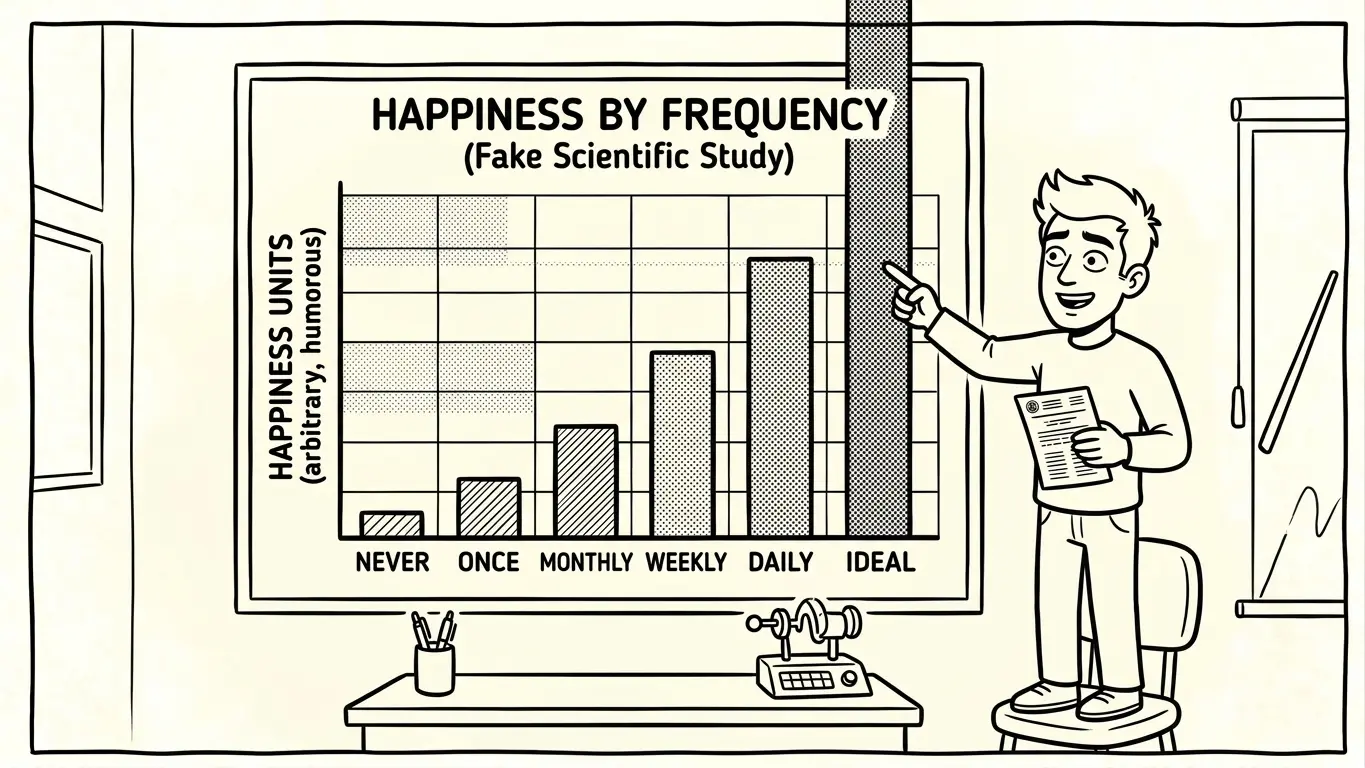
When the frequency of actual intimacy drops, the gap between what he’s thinking about and what’s happening gets wider. He may not name that gap out loud. He may not name it at all. But it registers.
The Part Worth Knowing
He is probably not going to tell you any of this in the way it’s being laid out here. The information lives in him as feeling, not as sentence structure.
But if you’ve ever sensed that intimacy matters to him in a way that goes beyond the physical, that he’s more affectionate, easier to be around, more himself after you’ve connected. The research gives that intuition a foundation. It’s not incidental. For many men, physical intimacy is one of the primary ways they experience emotional closeness. The thought frequency is a symptom of that. It’s not separate from the relationship. It is the relationship, for him, in miniature.
He’s checking. Not obsessively. Just consistently. The Three Bs Field Diagnostic is a good way to read where the whole system stands right now.
This is an excerpt from Chapter 14 of Beers, Burgers and Booty. The full chapter covers what physical intimacy actually means to him emotionally, why frequency matters more than he can explain, and how the whole system connects. It’s in the book.