The 93% More Pizza Study Is Real and It's Hilarious
Researchers watched men eat in the presence of women and documented what happened. Spoiler: he was not just hungry. He was performing. With breadsticks.
Picture the scene.
It’s a casual Friday night. Pizza. Nothing fancy. You order two pies, sit across from each other, and eat. He has three slices. Then a fourth. Then, after a pause that suggests he is at least considering stopping, a fifth. You have two. Maybe two and a half.
You think nothing of this. Men eat a lot. This is known.
What you do not know is that researchers have been watching this exact scene play out in controlled settings and documenting, with great scientific rigor, that your man just ate roughly double what he would have eaten if you weren’t there.
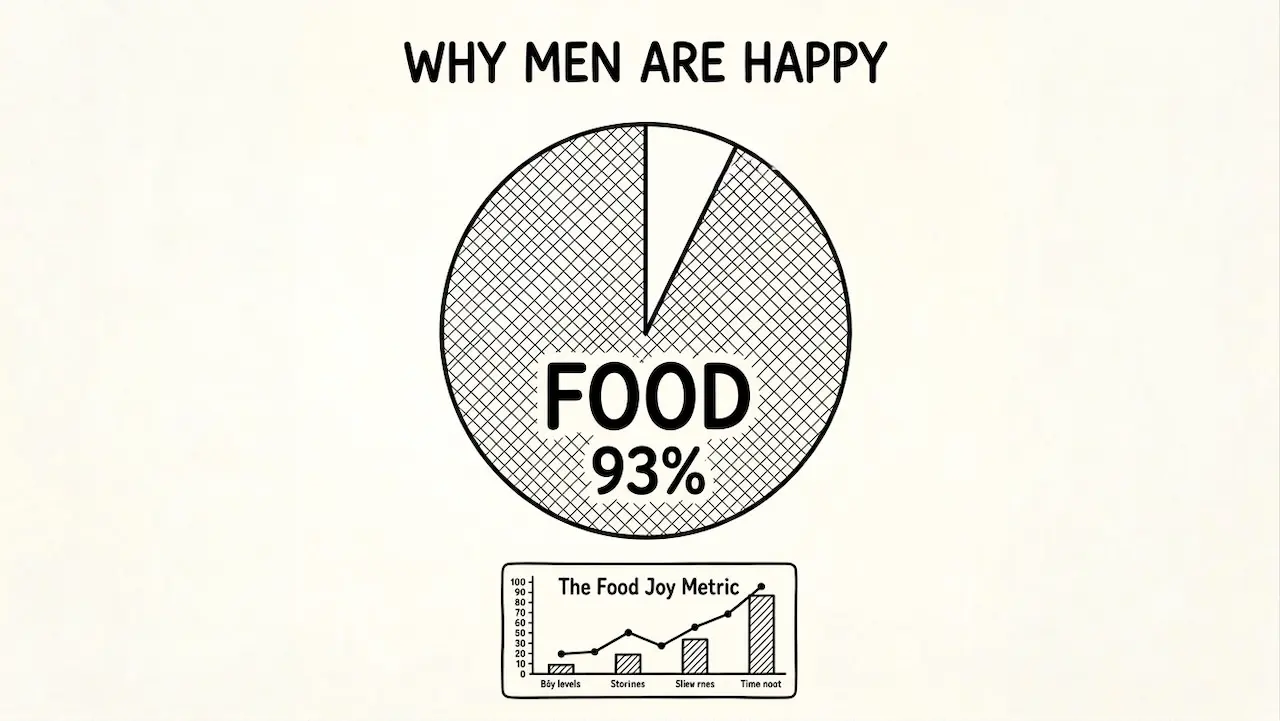
Ninety-three percent more pizza. That is not a rounding error. That is not “he was just hungry.” That is a man whose ancient brain kicked in the moment you sat down across from him and whispered, somewhere below conscious thought: show her what you’ve got.
He showed her. With breadsticks.
What the Study Actually Found
Evolutionary Psychological Science published research tracking food consumption by gender and group composition. The findings:
- Men eating with other men: normal amounts
- Men eating alone: normal amounts
- Men eating in the presence of women: significantly, statistically, almost comically more food
Ninety-three percent more pizza. Eighty-six percent more salad. The salad number is the one that gets me, because that means he ate nearly double the salad, and no man on earth woke up that morning thinking “I really want to impress someone with my leafy green intake today.” His brain just decided: more is better, she should see this, activate the consumption display.
The researchers’ explanation involves evolutionary biology, competitive signaling, and the ancient male drive to demonstrate physical capability and resource abundance to potential mates. Which, translated: he is peacocking with a fork.
He does not know he is doing this. This is the important part. He is not sitting across from you thinking “I will eat an impressive amount of food to signal my vitality.” He is just eating pizza and feeling unusually good about it. The signaling is happening several floors below where his conscious mind operates, in a part of the brain that has not received the update that it is 2026 and this strategy is not particularly useful.
It is, however, extremely charming once you know what it is.
What Else He’s Showing Off
The pizza is just the most documented example. Once you know the pattern, you see it everywhere.
He orders the bigger thing. At a restaurant where you might get the salmon, he is getting the ribeye. At the ballpark, he is getting the large. At the barbecue, he volunteered to man the grill, not necessarily because he is skilled at it (the evidence is mixed), but because standing over fire with tongs is a form of providing that his nervous system finds deeply satisfying.
Men eat more meat than women across virtually every culture that has been studied, and the gap gets larger the more freedom people have to choose. This is not purely about taste. It is something older than taste. The steak is not just dinner. It says: I am a person with the appetite of someone who does things.
None of this is conscious. All of it is real. All of it is happening at your dinner table, which is either slightly unsettling or very funny, depending on your mood.
The Secret Eating He Does When You’re Not Around
Here is the flip side.
When you are not there, his eating habits change. Dramatically. Privately. In ways he will never fully disclose.
The gas station stop on the way home from work. The thing from the drive-through that he ate before dinner, which is why he seemed less hungry than expected when he sat down. The late-night pantry visit that involved crackers and peanut butter eaten standing at the counter in the dark, in the specific posture of a man who is not going to mention this to anyone.
Research confirms what you probably already suspected: men are statistically prone to concealing evidence of junk food consumption before returning home to eat normal meals. The taquito gets eaten in the car. The fast-food bag goes in a gas station trash can three exits before home. He arrives looking like a man who has not eaten since lunch, because the performance requires it.
This is not deception. It is compartmentalization. The man who eats 93 percent more pizza in front of you because he wants to look capable and abundant is the same man who eats gas station taquitos alone in his car because nobody is watching and he just wanted a taquito. Both of these men are him. They are simply operating in different contexts.
Why This Matters Beyond the Pizza
Food is how men mark moments, signal status, reward themselves, and receive care. It is a language. And like any language, it is more meaningful when someone else speaks it back to you. The meal he mentioned three weeks ago is a good example of what that looks like in practice.
When you bring him a snack he didn’t ask for, make the meal he mentioned once three weeks ago and forgot he mentioned, or just sit across from him at dinner instead of eating separately: you are speaking the language. You are telling him, in the clearest possible terms, that you see him, that you thought about what he needed, and that he is worth the attention.
He will eat 93 percent more pizza because of it.
And he will have no idea why he feels so good.
This is an excerpt from Chapter 8 of Beers, Burgers and Booty. The full chapter covers the Celebration Belly, the Competitive Eater he doesn’t know he is, and why a random Wednesday meal lands the way it does. It’s in the book.